About how I designed my clocks and other projects, the use of CAD , mostly FreeCAD
- Pendulum
- Escapements
- Gears
- Motor
Pendulum
The pendulum was born from a moment of curiosity.
Around 1602, Galileo Galilei noticed something while watching a chandelier swing in the cathedral of Pisa. Whether pushed gently or strongly, each swing took the same amount of time. A long swing, a short swing — same duration. He called it isochronism. He had no stopwatch. He used his own pulse.
For decades that observation sat quietly. Only near the end of his life, already blind, did he return to the idea of building a clock around it. He dictated the design to his son Vincenzo. He died before it was built.
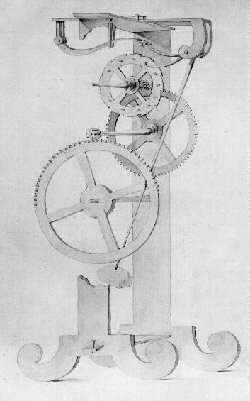
A pendulum to regulate a clock
Galileo Galilei (1564 – 1642) idea of using a pendulum to improve the accuracy of clocks
He explained his idea to Vincenzo Viviani, and this drawing made it to posterity
Learn more about the Galileo escapement here:
https://en.wikipedia.org/wiki/Galileo%27s_escapement
Illustration:
Vincenzo Viviani, Public domain, via Wikimedia Commons
https://upload.wikimedia.org/wikipedia/commons/8/8c/Galileo_Pendulum_Clock.jpg
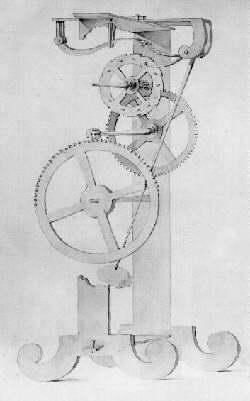
Christiaan Huygens finished the idea in 1656. He gets the credit. But the spark was Galileo’s.
How a Pendulum Keeps Time
A Simple Pendulum
A pendulum is a weight suspended from a fixed point, free to swing back and forth.
What makes it remarkable is consistency. Each swing takes the same amount of time — regardless of how wide the arc. Pull it far or barely at all, the rhythm stays the same. Galileo called this isochronism.
That consistency is exactly what a clock needs. The pendulum becomes the heartbeat — each swing releasing the gear train one step at a time through the escapement. Count the swings, count the seconds.
One variable controls everything: length. A longer pendulum swings slower, a shorter one faster. Adjust the length, adjust the rate. That’s how you regulate a pendulum clock.
A weight, a pivot, gravity. Nothing more.
The length of a pendulum determines its period — one complete swing there and back.
A one second pendulum, meaning one swing per second, is 994mm long — almost exactly one metre. This is not a coincidence. The metre was originally defined with this relationship in mind.
A half second pendulum swings twice per second and measures about 248mm — roughly a quarter of the length. Quarter the length, half the period.
A two second pendulum swings once every two seconds and requires about 3.97 metres. Tall grandfather clocks use a two second pendulum — one swing left, one swing right, tick tock, one full second each way.
The relationship is not linear. To double the period you need four times the length. This is the square root relationship at the heart of pendulum physics — the first piece of real mathematics hiding inside a swinging weight.
The coumpond pendulum
In theory there are two types. A simple pendulum — a single weight suspended below a fixed pivot. And a compound pendulum — where mass is distributed on both sides of the pivot point. In practice every real pendulum is compound. Even a plain rod with a bob has mass above the pivot. The simple pendulum is a useful concept for calculation, a clean model that makes the mathematics work. Reality is always more complicated.
What matters in practice is the effective length — the distance from the pivot to the centre of oscillation. That is what determines the period. The rating nut adjusts that effective length, giving you control over the rate of the clock.
Note: About centre of oscillation versus center of mass
Centre of mass is simply where the average weight sits. Centre of oscillation is a different point — it is the theoretical pivot location where a simple pendulum would swing at exactly the same rate. These two points do not coincide in a compound pendulum.
The useful thing — and this is elegant physics — the centre of oscillation and the pivot point are interchangeable. Flip the pendulum, hang it from what was the centre of oscillation, and the period stays identical. Huygens proved this in the 17th century.
So the correct statement is centre of oscillation. That is what the rating nut effectively adjusts — moving the bob changes where the centre of oscillation sits, which changes the equivalent length, which changes the period.
Practical use of a coumpound pendulum
A compound pendulum offers one practical advantage worth noting. By placing significant mass above the pivot as well as below, the effective length becomes shorter than the physical length. This means a one second pendulum — which as a simple pendulum would need nearly a metre — can be achieved in a much more compact form. Useful when space is limited, or when building a clock that needs to fit inside a case.
This is not a theoretical curiosity. It is why some bracket clocks and mantel clocks can beat once per second despite being relatively small instruments.
Example:
- Rod is 400mm total, steel rod M6. Pivot sits in the middle of rod
- Bob: 150g steel ball, 200mm below pivot
- Counterweight: 112g steel ball, 175mm above pivot
- Result: exactly 2 second period — one second each way
A physical pendulum that fits in your hand, beats like a grandfather clock.
Go to this page for a calculator and and a formula for you own design.
Escapements — The Heart of the Clock
If the pendulum is the rhythm, the escapement is the gatekeeper.
Its job is simple in principle: release the gear train one tooth at a time, in perfect synchrony with the pendulum’s swing. Without it, the weights would drive the gears to spin freely and the clock would run down in seconds. The escapement controls that energy — metering it out, tick by tick.
Every tick you hear is the escapement catching a tooth. Every tock is it releasing one.
Galileo understood this. Near the end of his life, already blind, he designed an escapement controlled by a pendulum — the first of its kind. He never saw it built. But the idea survived him, and Christiaan Huygens brought it to life in 1656. Every pendulum clock ever made traces its ancestry to that moment.
Over centuries of clockmaking, many escapement designs have been developed — each a different solution to the same problem. Some are simple and robust. Some are precise but delicate. Some were abandoned. Some changed everything.
A few of the most significant:
Verge and Foliot — the oldest known mechanical escapement, dating to the 13th century. No pendulum, no spring. Just a rotating bar and two flags catching a crown wheel. Crude by modern standards but revolutionary for its time.
Recoil Anchor — introduced in the late 17th century, designed to work with the pendulum. The escape wheel actually recoils slightly on each swing — hence the name. Simple, reliable, still common in longcase clocks today.
Graham Deadbeat — a refinement of the anchor escapement. Eliminates the recoil entirely, giving more accurate timekeeping. The standard for precision pendulum clocks.
Grasshopper — John Harrison’s eccentric invention. Almost frictionless, requiring no lubrication. Fascinating to watch, difficult to build.
Detached Lever — the escapement inside almost every mechanical watch ever made. A tiny anchor connecting the escape wheel to the balance wheel. Reliable, accurate, manufacturable at scale.
Each one is a different answer to the same question — how do you tame energy into time?
Graham escapement, Recoil escapement, Grasshoper escapement, Verge and Foliot,
Detached escapement with anchor and balance wheel in watches
These are jut a few of the most common types of escapements